
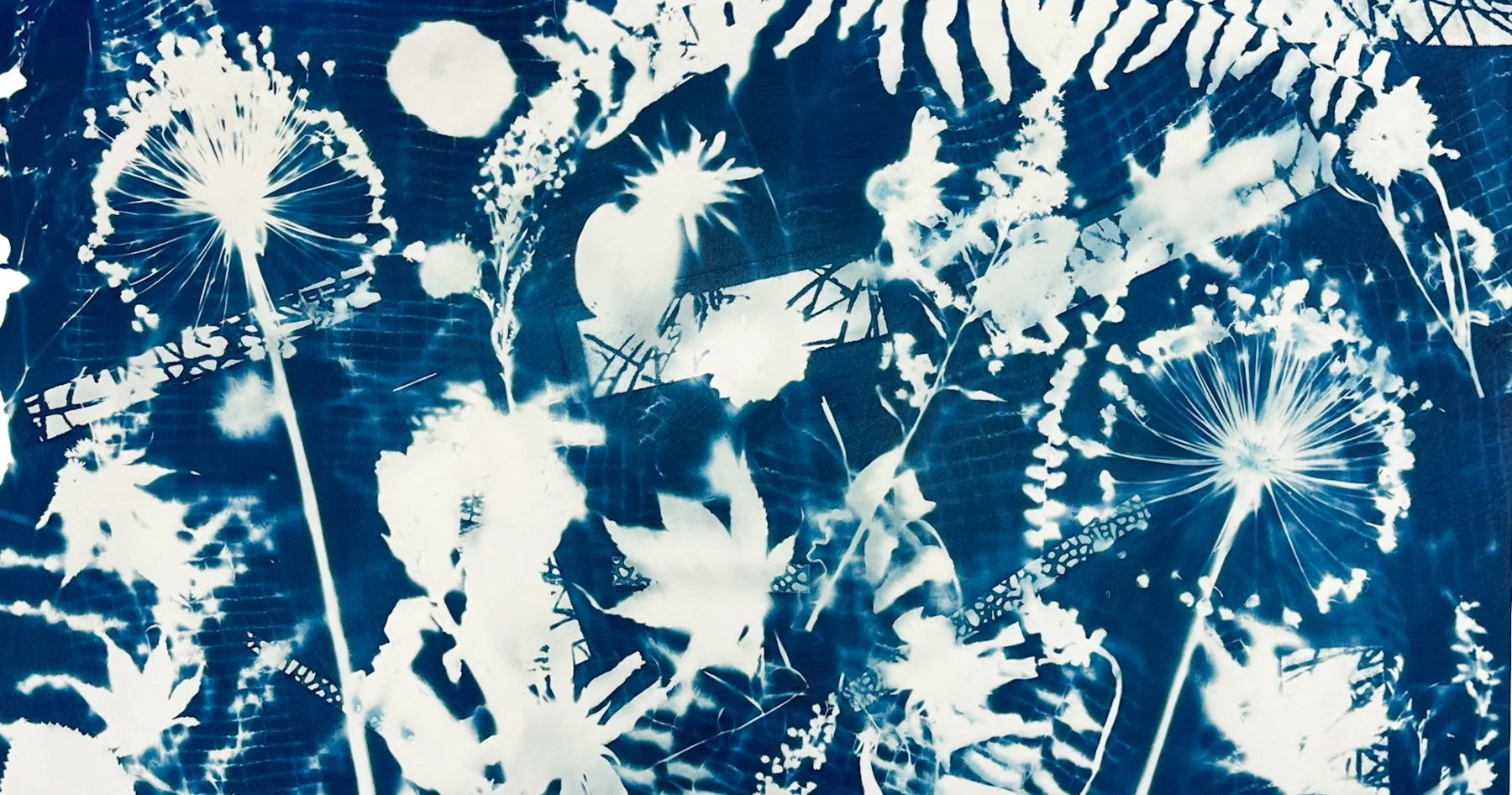
What is a Cyanotype?
A cyanotype is a photographic printing process renowned for producing stunning blue and white images. This creative technique was originally developed in the 19th century, thanks to the inventive mind of Sir John Herschel.
In my practice, each cyanotype begins with hand-assembled, collaged negatives and carefully collected botanicals and objects. Drawn from the landscape and everyday surroundings, these elements inform the patterns, textures, and layered compositions in each piece. The images are contact-printed onto paper or fabric coated with a light-sensitive solution of ferric ammonium citrate and potassium ferricyanide. When exposed to sunlight, the surface reacts, transforming light into deep blue pigment.
Each work is handmade and one of a kind, shaped by material, exposure, and chance.

Christine Holtz is a Pittsburgh-based artist and educator whose studio practice centers on cyanotype. Working with photographic negatives, botanicals, and layered exposures, she uses the historic blue-printing process to create images that explore light, time, and surface. Her interest in material-based image making began early and has evolved into a sustained engagement with cyanotype as both a photographic and tactile medium.
Christine earned her BFA from the Rhode Island School of Design and her MFA from the Rochester Institute of Technology. She is a member of the Associated Artists of Pittsburgh, the Fiberarts Guild of Pittsburgh, and the Pittsburgh Center for Arts & Media.
Her broader photographic work can be viewed at www.christineholtz.com.
